

Understanding the Unit Circle
If you asked me to name the most misunderstood and poorly taught subject in Math, I’d have to say that it’s Trigonometry by far. The number one reason for that is the issue of Unit Circle memorization.
Trig happens to be a very visual subject in the sense that it’s based around the Unit Circle. That’s a form of graphing knowledge and without it, you’re pretty much lost. Unfortunately, I’ve probably never met a student who had a teacher that taught it well.
But there is a simple way to learn it and approach it. Here’s how I’ve learned to look at it:
The first thing to realize is that the Unit Circle is simply the graph of a circle that has a radius length of 1 (that’s what the “unit” in Unit Circle is referring to).
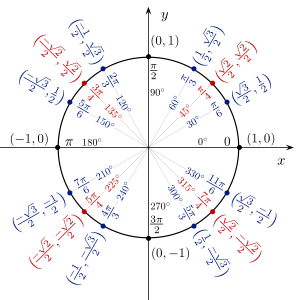
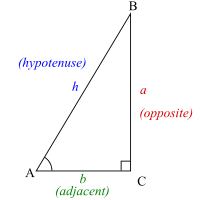
The second thing to realize is that the points on the Unit Circle show you the heights and widths of a right triangle formed at specific angles, given in x, y coordinates (cosine, sine). See the right triangle below.
- The sine of an angle gives you the height (vertical distance) at that angle (from the x-axis). The cosine of an angle gives you the width (horizontal distance) at that angle (from the y-axis). These points can be represented using a right triangle (see below):
- Sin A represents the length of side BC (height)
- Cos A represents the length of side AC (width)
The third thing to realize is that you’re only expected to know sine and cosine for specific angles in the unit circle. There are two main angle families to know:
- The 30 degree angles: 0, 30, 60, 90 120, 150, 180, 210, 240, 270, 300, 330, 360
- The 45 degree angles: 0, 45, 90, 135, 180, 225, 270, 315, 360
As you can see, they have a few angles in common: 0, 90, 180, 360
The fourth thing to know is that you can greatly simplify the mental effort and memorization needed to understand the Unit Circle by using the method of symmetry.
Remember, this is just a graph of a circle. That means that knowing the values of the angles in the first quadrant makes it easy to see what the values will be in the other three quadrants, since reflection across the x and y axis will lead to either be equal or negative values.
Therefore, you should start by focusing on the first quadrant values at these angles: 0, 30, 45, 60, 90.
Now that you’ve simplified the unit circle down to only five angles, you need to start by knowing the sine and cosine values at these five angles. Instead of memorizing through brute force, let’s try to “understand” the overall pattern here:
- An easy way to remember pattern for sine going from 0 to 90 is: √0, √1, √2, √3, √4
- When you simplify the radicals, these values become: 0, 1, √2, √3, 2
- Divide each value by 2, and now you have your sine values for 0, 30, 45, 60, and 90 degrees, which are: 0, 1/2, √2/2, √3/2, 1
- You can use a similar pattern to find all of your cosine values from 90 down to 0
Go back up and check out the Unit Circle to see if you can see this pattern in the 1st Quadrant of the circle
- One more thing that you should notice is that for any given angle, it appears that the numbers inside the radical for a cosine and its corresponding sine have a sum of 4:
- 0 and 4, 1 and 3, 2 and 2 each add up to 4 four inside of the radical for √0/2 and √4/2, √1/2 and √3/2, and √2/2 and √2/2
Try this out with any angle in the first quadrant and see if it holds
If you can understand this pattern, you’re further ahead in understanding the Unit Circle than nearly every new student I’ve tutored. You’ve also gotten the most important and hardest concept to understand in Trig. Happy studying!
0 comments